
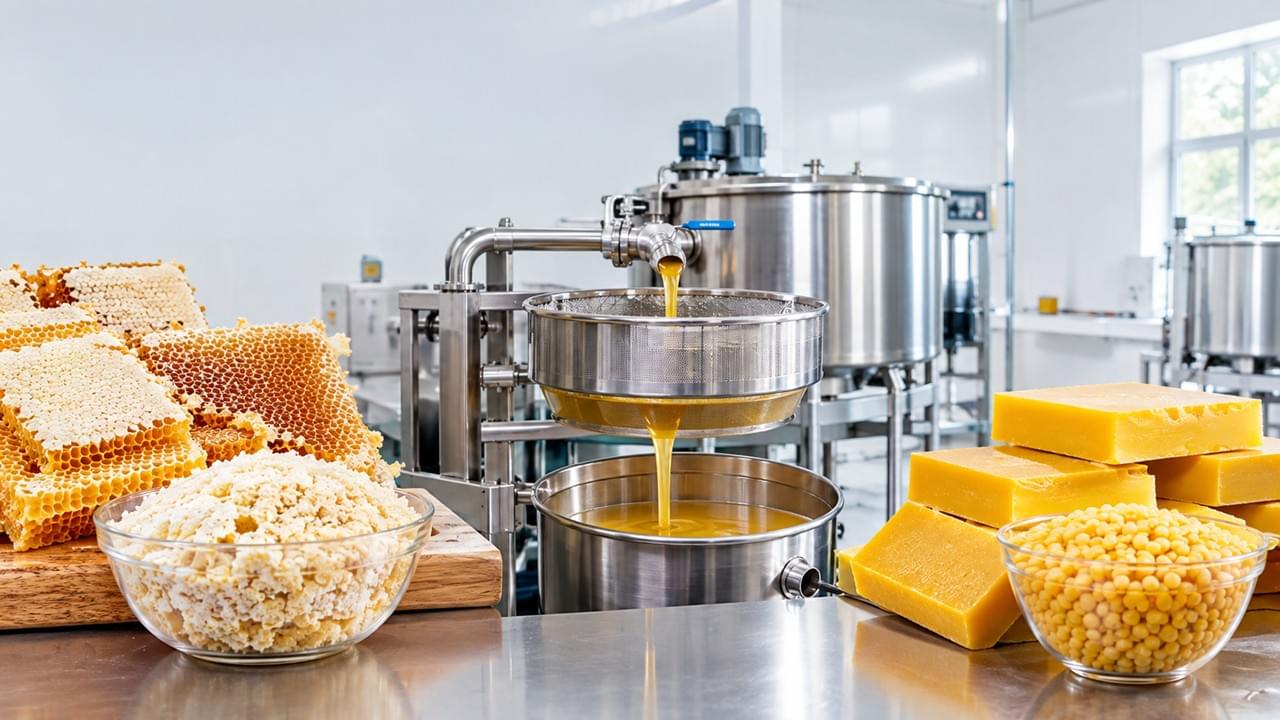
Beeswax is easy to overlook when honey is the main product of an apiary. Yet for beekeepers and honey processors, beeswax processing can turn recovered comb and cappings into a useful commercial resource. Instead of treating wax as waste, a well-organized workflow can produce cleaner wax for candles, foundation sheets, cosmetics, pharmaceutical applications, and other specialty products. The key is to handle the material carefully from the hive to the final block.
Table of Contents
Toggle🐝 Where Does Beeswax Come From?
Beeswax comes mainly from honeycomb and wax cappings. Cappings removed during honey extraction are usually lighter and cleaner, while older brood comb tends to contain more pollen, propolis, cocoons, and other residues. FAO notes that cappings generally provide higher-quality, light-colored wax than old dark brood comb.
This makes sorting important before beeswax processing begins. Separating cleaner cappings from darker or heavily contaminated comb can reduce the burden on later filtration and help create more consistent batches.
For businesses already handling honeycomb products, the same production chain can create another opportunity: recover suitable wax instead of discarding it.
🔥 Beeswax Processing Step 1: Collection and Sorting
The first step is simple, but it affects every stage that follows.
Remove visible debris such as wood fragments, dead bees, excess propolis, and other foreign materials. Then separate wax according to its source, color, and condition.
Fresh cappings are particularly attractive when the final product requires a cleaner appearance. Older comb can still be valuable, but it normally requires more intensive cleaning.
Good sorting saves time later. It also helps buyers establish clearer specifications when wax is collected from multiple apiaries or processing locations.
♨️ Beeswax Processing Step 2: Controlled Melting
Raw wax must be melted before impurities can be separated. Beeswax melts at temperatures above 60°C, and traditional methods may use hot water, steam, or solar wax melters. FAO also recommends considering energy efficiency when choosing a melting method.
The objective is not simply to heat the wax as quickly as possible. Controlled heating helps avoid unnecessary overheating while making the wax easier to separate from solid residues.
For larger operations, beeswax processing equipment can provide more consistent heating and improve handling compared with improvised containers or small-scale manual methods.
🧹 Beeswax Processing Step 3: Filtration and Separation
After melting, the liquid wax still contains unwanted particles. Filtration removes much of this material before the wax is formed into blocks or sent through additional purification.
A basic filter may be sufficient for general beekeeping applications, while higher-value applications may require more careful purification. The choice should depend on the intended end use rather than applying the same process to every batch.
One practical rule is worth remembering: cleaner raw material usually means less work later.
✨ Beeswax Processing Step 4: Refining for Better Quality
This is where the beeswax refining process becomes especially important.
During refining, impurities can be separated through settling, filtration, repeated melting, or other suitable methods. The result should be cleaner, more uniform wax with fewer visible residues.
Color can also provide useful information. Light-colored wax is generally more desirable for applications where appearance matters, while dark wax may indicate older comb or greater contamination. FAO guidance likewise identifies purity and color as important considerations when evaluating beeswax.
However, color alone should not be treated as a complete quality test. Buyers should also consider the source, processing history, intended application, and applicable quality requirements.
🧱 Beeswax Processing Step 5: Molding and Cooling
Once the wax has been sufficiently cleaned, it can be poured into molds and allowed to cool.
Blocks are practical for storage and bulk transportation, while other forms may be more suitable for downstream manufacturing. Foundation production, for example, requires additional forming rather than simply producing standard wax blocks.
A standardized shape also makes weighing, stacking, inventory control, and shipment preparation easier. For exporters and bulk buyers, consistent batch presentation can make warehouse management much more efficient.
📦 Beeswax Processing Step 6: Storage and Traceability
Clean beeswax should be stored in a cool, dry environment and protected from contamination. FAO recommends keeping wax away from pesticides and notes that properly stored wax can remain stable for long periods.
For commercial operations, storage is also a traceability issue.
Record the wax source, collection date, batch number, processing date, and destination where practical. This becomes increasingly valuable when wax is supplied to manufacturers that need consistent raw materials or supporting documentation.
Delee’s approach to standardized production and traceability can provide a useful reference for businesses looking to strengthen their broader bee-product supply chain.
💡 Beeswax Processing Step 7: Turn Wax Into Higher-Value Products
The real value of beeswax processing appears after purification.
🕯️ Commercial Beeswax Uses
The most familiar application is candle making, but commercial beeswax uses extend much further. Beeswax is also used in foundation sheets, cosmetics, pharmaceutical preparations, polishes, coatings, and other specialty products. FAO describes beeswax as a versatile hive product with significant value-added potential.
Delee’s overview of natural beeswax uses also covers applications in food processing, candle making, and other product categories, making it a useful internal reference for buyers exploring downstream markets.
The right application depends on the wax’s cleanliness, color, processing history, specifications, and regulatory requirements.
🚀 Why Better Beeswax Processing Matters
A good wax recovery system does more than reduce waste. It helps beekeepers extract additional value from resources already produced by the colony.
For commercial apiaries, honey processors, cooperatives, and bee-product suppliers, the opportunity is straightforward: collect suitable wax, separate it carefully, refine it consistently, and match the final material to the right market.
With appropriate beeswax processing equipment, even a secondary hive product can become a more organized and potentially profitable part of the overall operation.
For companies building a wider bee-product supply chain, combining honey, honeycomb, and beeswax resources can also support a more complete product portfolio.
🐝 Final Thoughts
Beeswax processing does not have to be complicated, but it should be systematic. From selecting suitable comb and controlling the melting stage to filtering, refining, molding, and storing the finished wax, each step influences the final result.
The most important lesson is simple: beeswax is not merely leftover material from honey production. When handled properly, it is a valuable hive product with multiple commercial possibilities.
For beekeepers and professional buyers, investing in better processing methods can turn a small secondary resource into a reliable addition to the value of the entire apiary.