
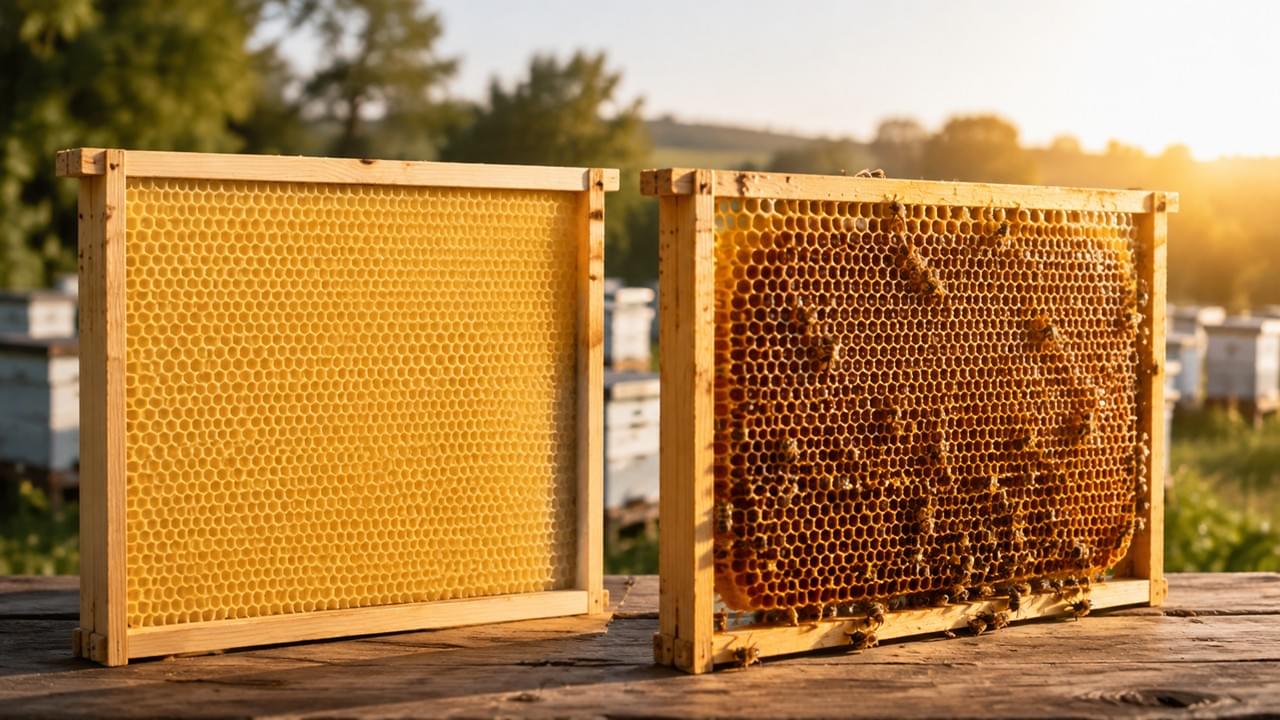
For every beekeeper trying to improve hive productivity, the choice between beeswax foundation and drawn comb deserves more attention than it often receives. At first glance, the two may seem like simple frame components. In practice, however, they can influence how quickly bees establish usable comb, how much energy the colony spends producing wax, and how soon a hive can make productive use of additional space.
The right choice is not necessarily one or the other. Strong colonies, newly established hives, expanding brood nests, and honey-producing colonies can have very different needs. Understanding those differences allows beekeepers to use each option strategically rather than treating foundation and drawn comb as interchangeable materials.
Table of Contents
ToggleWhy Beeswax Foundation Matters in Hive Development
Beeswax foundation provides bees with a starting structure for building comb. Instead of beginning with a completely empty frame, workers receive a prepared sheet that guides them toward producing relatively uniform cells.
This basic function is important because properly installed foundation can help encourage straight comb construction. Straight frames are easier to inspect, manage, maintain, and eventually use in honey harvesting equipment.
The source document identifies foundation as an important part of the hive equipment chain and specifically describes its role as guiding bees in comb construction and providing structural support. It also recommends pairing foundation with frames and a foundation embedding tool for efficient installation.
For new colonies, this starting point can be particularly useful. A beekeeper is not simply buying wax; they are creating a framework that helps the colony develop organized comb within the equipment.
Beeswax Foundation and the Hidden Cost of Wax Production
One of the most important reasons to understand the difference between foundation and drawn comb is energy.
Honey bees do not build wax comb for free. Producing wax requires resources, and those resources could otherwise support other colony activities. According to the source material, approximately 25 pounds of honey may be required for bees to draw 10 medium-depth frames of comb.
That figure provides a useful way to think about comb management.
If a strong colony spends a significant amount of its available resources constructing large quantities of new comb during an important nectar flow, some of the colony’s productive capacity is being directed toward construction rather than honey storage.
This does not make new comb undesirable. New comb is often necessary. The key is timing.
A beekeeper should ask a simple question before adding multiple foundation frames:
Does the colony have enough strength and available resources to draw this comb without slowing its main production goals?
That question can lead to better equipment decisions.
The Productivity Advantage of Drawn Comb
Drawn comb is essentially a ready-made working structure. The bees do not have to build the basic wax architecture before using it.
This is where drawn comb can offer a major productivity advantage.
When bees receive usable drawn cells, they can begin storing nectar, processing honey, or expanding brood space more quickly. The source document specifically highlights the benefit of drawn comb as a way to save bee energy and accelerate honey storage.
For a colony entering a strong nectar flow, that difference can matter.
Imagine two otherwise similar colonies. One receives several frames of foundation and must invest considerable effort into drawing them. The other receives properly prepared drawn comb and can immediately begin using the available cells.
The second colony has less construction work to complete before productive activity can take place.
This is why drawn comb vs foundation should be considered a management decision rather than simply a material preference.
When to Use Beeswax Foundation
There are several situations where beeswax foundation makes practical sense.
1. Building New Comb
When a beekeeper needs to expand the amount of comb available in the apiary, foundation provides a controlled starting point. It is particularly useful when building new frames or establishing a new set of equipment.
The source document recommends foundation as part of spring colony development and also connects it with expanding hive space and managing growing colonies.
2. Replacing Old or Damaged Comb
Comb does not remain equally useful forever. Beekeepers may eventually remove frames that are excessively dark, damaged, or otherwise unsuitable for continued use.
New foundation gives the colony an opportunity to create fresh comb.
3. Expanding an Apiary
Beekeepers managing multiple colonies need a practical way to maintain a steady supply of usable frames. Foundation can be installed into new frames before they are needed, creating an organized equipment pipeline.
For commercial operations, standardized frames and reliable foundation can also simplify preparation and inventory management.
4. Supporting Controlled Comb Construction
Foundation can help guide bees toward consistent comb placement. This is especially valuable in equipment systems where straight, interchangeable frames are important.
Good frame preparation is therefore part of productivity management, not merely equipment maintenance.
When to Use Drawn Comb
Drawn comb becomes particularly valuable when speed matters.
1. During a Strong Nectar Flow
When nectar is coming into the hive rapidly, the colony’s priority is often to process and store that incoming resource efficiently. Giving bees usable cells can reduce the amount of time and energy required for construction.
This is one reason drawn comb is often attractive to beekeepers focused on honey production.
2. When Rapid Hive Expansion Is Needed
A growing colony may need additional usable space quickly. Adding drawn comb can give bees immediate access to cells for brood or food storage.
The document’s section on super management specifically recommends considering drawn comb rather than foundation when the objective is improved honey production.
3. When Colony Resources Are Limited
A weaker colony may not be in the best position to produce large amounts of new wax. In such cases, already drawn comb can reduce the construction burden.
However, colony strength, local nectar availability, and seasonal conditions should always be considered before making the decision.
Drawn Comb vs Foundation: A Practical Comparison
| Factor | Beeswax Foundation | Drawn Comb |
|---|---|---|
| Initial structure | Requires bees to draw cells | Cells already available |
| Bee energy demand | Higher | Lower |
| Speed of use | Depends on colony drawing ability | Generally faster |
| Best for | Building new comb | Rapid production and expansion |
| Honey-flow advantage | Moderate | Strong when usable comb is needed quickly |
| Equipment planning | Excellent for new frames | Valuable for ready-to-use frames |
| Long-term management | Useful for comb replacement | Requires careful comb quality management |
The important point is that neither option is universally superior.
Foundation helps create the comb infrastructure an apiary needs. Drawn comb helps a colony make immediate use of existing infrastructure.
The strongest beekeeping strategy often involves having both available.
How Comb Choice Can Affect Honey Production
Honey production depends on much more than the type of frame used. Colony strength, queen performance, forage availability, weather, disease pressure, nutrition, hive configuration, and timing all play important roles.
However, comb availability can influence how efficiently a colony uses the space provided to it.
The source document emphasizes that excessive comb construction can consume substantial honey resources and potentially slow honey production and brood development. It therefore recommends focusing on the efficiency advantages of drawn comb or quality foundation.
This is especially relevant when managing supers.
If a colony is approaching a major nectar flow, the beekeeper should avoid waiting until the bees are already crowded before providing usable storage space. Timely super management can help reduce congestion and support continued production.
The document also connects proper super management with swarm prevention, noting that timely addition of supers and adequate space can help address overcrowding.
Beeswax Foundation for Honey Production: Quality Still Matters
Choosing foundation is not simply about deciding between wax and drawn comb. The quality of the foundation and the way it is installed also matter.
A well-prepared frame should provide a stable starting point for comb construction. Foundation should be properly fitted, secured, and aligned so that bees are encouraged to build straight comb.
The source specifically identifies foundation, frames, and foundation embedding tools as complementary equipment.
For suppliers and commercial beekeepers, this creates an important procurement consideration: foundation should be evaluated together with frame compatibility and installation requirements rather than purchased as an isolated component.
How to Build a Balanced Comb Strategy
A productive apiary does not need to choose one method permanently.
Instead, consider creating a simple comb strategy:
🌱 New frames → Beeswax foundation
Use foundation when the objective is to increase the amount of comb available in the apiary or replace older comb.
⚡ Rapid expansion → Drawn comb
Use drawn comb when the colony needs immediately usable space, particularly when nectar is arriving quickly.
🍯 Honey production → Prioritize usable storage space
During an important honey flow, minimizing unnecessary construction work can help the colony concentrate on processing and storing nectar.
🐝 Colony development → Match comb to colony strength
Strong colonies with adequate forage can generally handle more comb-building work than weak or resource-limited colonies.
This flexible approach is more practical than following a fixed rule for every hive.
5 Questions to Ask Before Choosing
Before installing foundation or drawn comb, ask these five questions:
- How strong is the colony right now?
- Is a significant nectar flow approaching or already underway?
- Does the colony need brood space or honey-storage space?
- Do I have enough drawn comb available for rapid expansion?
- Am I trying to build new comb or maximize current production?
The answers can make the decision much clearer.
A beekeeper building an equipment inventory may prioritize foundation. A beekeeper preparing a strong production colony for a major nectar flow may place greater value on drawn comb.
Choosing the Right Equipment for Efficient Comb Management
Comb management works best when the supporting equipment is reliable.
Frames must hold the foundation securely, while a suitable embedding tool can help create a stable connection between foundation and frame. The source document specifically recommends Delee’s range of foundation, frames, and embedding tools as part of this equipment system.
For beekeepers managing multiple colonies, standardizing frame sizes and maintaining a dependable supply of replacement foundation can also make seasonal preparation easier.
👉 If you are planning to expand your apiary or replace existing comb, explore the Delee beekeeping equipment range for foundation, frames, and related hive equipment.
For broader hive management, foundation should also be considered alongside supers, queen-management tools, feeders, and other equipment. The source strategy document presents Delee as a one-stop supplier covering hive equipment, frames, foundation, smokers, protective equipment, honey extraction tools, feeders, and queen tools.
Final Takeaway: Use the Comb That Fits the Job
The debate between beeswax foundation and drawn comb does not have a single winner.
Foundation is valuable because it gives bees a structured starting point and helps beekeepers build new comb in an organized way. Drawn comb is valuable because it saves the colony from having to construct that structure again and can accelerate the use of available hive space.
The most important consideration is therefore timing.
If your goal is to build comb infrastructure, foundation is an essential tool. If your colony needs immediate storage or brood space during an important production period, drawn comb can provide a significant efficiency advantage.
Most importantly, remember that every pound of honey used for wax production represents resources that cannot simultaneously be used for other colony activities. The source material’s estimate of roughly 25 pounds of honey for 10 medium frames illustrates why thoughtful comb management deserves a place in every productivity strategy.
🐝 Smart beekeeping is not about choosing one material forever. It is about giving the colony the right structure at the right time.
If you are sourcing beeswax foundation, frames, or other beekeeping equipment for your apiary, Delee can support different operating scales with a broad equipment range and technical support. The company also emphasizes flexible small-order quantities and support for new customers, making it suitable for both developing and established beekeeping operations.
Ready to improve your hive setup? Contact Delee to discuss the right foundation, frames, and beekeeping equipment for your operation.